
WITH JUST ONE SENTENCE, TRUMP MADE MELANIA’S HEART SKIP A BEAT — AND LEFT THE ENTIRE ROOM SILENT WITH EMOTION1!

As the final minutes of the year slipped away at Mar-a-Lago, the atmosphere inside the grand ballroom felt unusually restrained. The chandeliers glowed softly, music hummed in the background, and guests—political allies, donors, longtime supporters—waited for the familiar crescendo of applause and celebration that typically marks the arrival of a new year in Trump’s Florida stronghold.
But this night unfolded differently.
When Donald Trump stepped forward just before midnight, there was no theatrical buildup. No extended toast. No rally-style cadence. Instead, he spoke briefly, deliberately, and with a tone that immediately altered the room’s energy.
“We want peace on Earth,” Trump said, his voice calm, measured, and assured. “And we will get to the bottom of what’s been done to the American people.”
The effect was instant. Conversations stopped. Glasses froze midair. The ballroom, moments earlier alive with anticipation, fell into a rare and palpable silence.

It was not the volume of Trump’s words that commanded attention, but their restraint. In a political era defined by noise, the simplicity of the statement carried unexpected weight. Peace—spoken without flourish. Accountability—invoked without naming names. It was a message that pointed forward without revealing its full destination.
Standing beside him was Melania Trump.
She did not speak. She did not gesture toward the crowd. Yet her presence became one of the most discussed elements of the evening. As Trump delivered his message, Melania reached for his hand, a small but unmistakable movement that cameras and guests alike caught in the stillness of the moment.
Media observers later described her appearance in near-unison: calm, composed, and unwavering.
Melania Trump has long been known for her selective visibility, choosing moments carefully and speaking sparingly. That night was no exception. She did not deliver a speech. She offered no remarks of her own. Yet she remained at her husband’s side throughout the critical moments, particularly as Trump articulated his call for peace and his vow to pursue the truth behind what he characterized as grave wrongs against the American people.
For supporters, the image spoke louder than any prepared remarks could have.

To many watching, Melania’s presence conveyed a clear message: the Trump family is united—and not retreating.
In the weeks leading up to the new year, political pressure on Trump had intensified. Legal battles, investigations, and renewed scrutiny of past and present policies had once again pushed him into the center of national debate. Against that backdrop, the quiet solidarity displayed on the Mar-a-Lago stage took on heightened meaning.
“This wasn’t about optics,” one attendee later remarked. “It felt personal. Deliberate. Almost protective.”
As midnight struck, there was no eruption of cheers. No confetti cannons. Applause came slowly, cautiously, as if the crowd was still processing what had just been said—and what had been left unsaid.
Trump did not linger at the podium. He did not expand on his remarks or offer further explanation. Instead, he stepped back, leaving behind a sense that the new year had been marked not by celebration, but by intent.
Observers noted that the phrase “peace on Earth,” delivered in such a setting and at such a time, carried dual significance. On the surface, it echoed a traditional New Year’s wish—universal, almost timeless. Yet paired with his pledge to “get to the bottom” of actions taken against the American people, it suggested a broader framing: peace not as passivity, but as order restored through accountability.
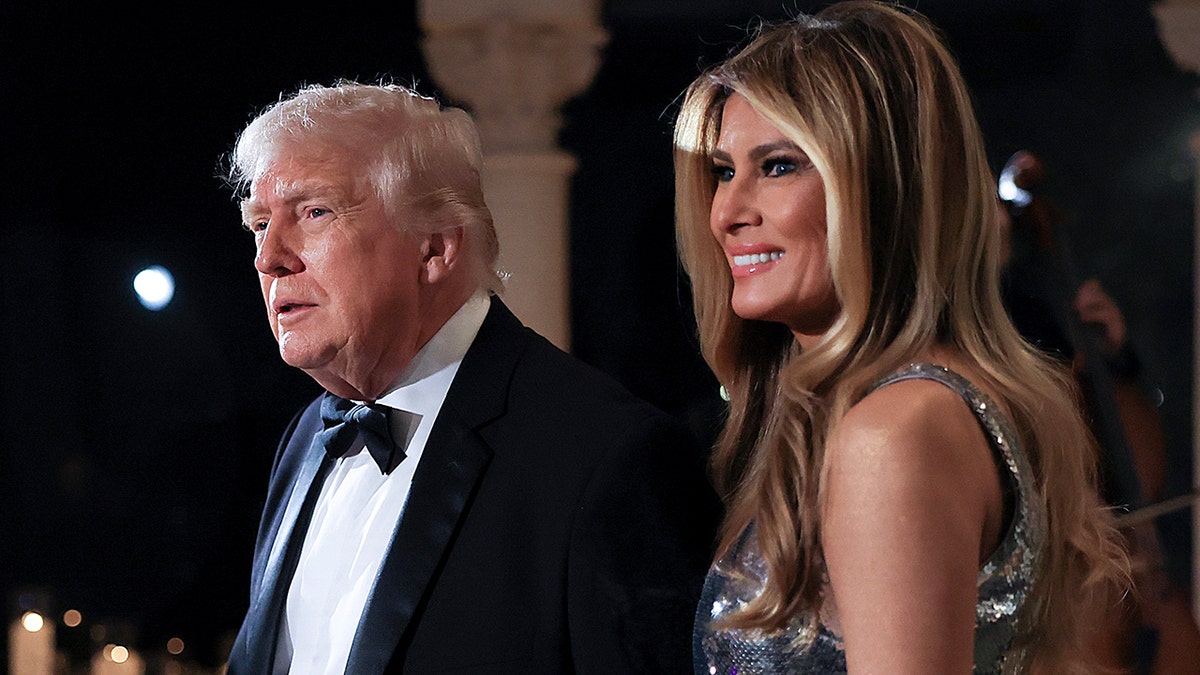
Melania’s role in that framing was subtle but unmistakable. Throughout Trump’s political career, her public appearances have often been interpreted as signals—of stability, continuity, or resolve. That night, her quiet composure reinforced the sense that the moment was not improvised. It was chosen.
“She didn’t need to say anything,” said another guest. “Her presence answered the question before anyone asked it.”
As guests slowly resumed conversation and the evening moved forward, the earlier stillness lingered like an afterimage. What had been spoken could not be undone or easily categorized. It resisted headlines, yet invited them. It felt less like a conclusion to the year than an opening statement for the one ahead.
For critics, the moment would be dissected for subtext and strategy. For supporters, it became something simpler: reassurance. A sign that Trump was neither distracted nor diminished, and that his inner circle—beginning with his family—remained intact.

In the days that followed, images from the night circulated widely: Trump speaking without spectacle; Melania standing close, her hand in his. Commentators debated the meaning, the timing, the implications. But for those in the room, the memory was more visceral than analytical.
It was the silence they remembered.
A silence that fell not out of confusion, but recognition. Recognition that the year had turned with more than a countdown—that it had opened with a signal. One that suggested calm before confrontation, unity before explanation, and a leadership style that, for better or worse, remains deeply rooted in conviction rather than consensus.
As the first hours of the new year passed, one impression endured among those who witnessed it firsthand: whatever Donald Trump intended to pursue next, he had chosen to announce it not with force, but with composure—and with Melania Trump firmly at his side.
And in that quiet alignment, supporters found a message of their own: this chapter is far from over.
TRUMP STARES AT PRISON AS THE GOP BREAKS RANKS — THE NIGHT 50 REPUBLICANS CROSSED THE LINE!001

Washington has witnessed countless moments of political theater, but few imagined a night like this — a night defined not by shouting crowds or dramatic walkouts, but by quiet numbers written on a Senate tally board.
Fifty.
In this hypothetical scenario, that number becomes the fulcrum upon which an entire presidency tilts.
For weeks, rumors had circulated through Capitol Hill corridors about a closed-door briefing that left even seasoned lawmakers visibly shaken. Senators emerged pale, tight-lipped, refusing to engage reporters beyond curt acknowledgments. The briefing, they said, was unlike anything they had encountered before — not because of a single explosive revelation, but because of a pattern that, when laid bare, felt impossible to ignore.
What followed was not an immediate eruption, but something far more unsettling: silence, calculation, and fear.

A Senate Forced Into Uncharted Territory
Convicting a sitting president is no small matter. The Constitution sets a high bar — a two-thirds majority, 67 votes — deliberately designed to prevent partisan revenge. In a sharply divided Senate, that threshold appears nearly unreachable without a political earthquake.
And then it happens.
In this scenario, fifty Republican senators break ranks and side with Democrats.
Not quietly. Not gradually. But decisively.
It is a moment that shatters assumptions about party loyalty and political survival. These are not fringe figures or retiring lawmakers with nothing to lose. They include committee chairs, party elders, and rising stars — individuals who built their careers defending conservative principles and, in many cases, supporting Donald Trump himself.
So what changed?
According to those familiar with the proceedings, it wasn’t ideology. It wasn’t polling. And it certainly wasn’t political pressure from the opposition.
It was fear — fear of an executive branch operating without meaningful restraint.
Beyond Past Misconduct
What makes this scenario particularly chilling, senators say, is that the case is no longer centered on past behavior. The concern is not merely what has already happened, but what appears to be ongoing.
Evidence presented during the briefing allegedly points to continued obstruction — actions taken not to protect national interests, but to shield personal exposure. Lawmakers are shown financial records, communications, and intelligence assessments that, taken together, suggest a president increasingly cornered.
And a cornered president, they fear, is a dangerous one.
Several senators reportedly describe the same realization: waiting for the next election is no longer a neutral act. It is a gamble — one that risks national security itself.
“A president facing criminal jeopardy doesn’t behave like a normal president,” one senator is quoted as saying in private. “He behaves like someone trying to survive.”
The Breaking Point
The vote, when it comes, is not accompanied by cheers or celebration.
It is heavy.
One by one, senators rise to explain their decisions. Some speak of constitutional duty. Others invoke history — moments when institutions failed because individuals chose comfort over courage.
Several Republicans explicitly acknowledge the political cost of their decision. They speak of donors lost, careers likely shortened, and friendships shattered. But they return again and again to the same refrain: this is bigger than any one man.
This is about the system.
When the final tally is announced, the chamber does not erupt. There is no applause. Only a stillness that settles over the room as the weight of the moment sinks in.
The Senate has convicted a sitting president.
What Conviction Means
In this scenario, the consequences are immediate and profound.
A Senate conviction strips the president of immunity — a legal shield that exists only so long as the officeholder retains the office. Once removed, the presidency no longer serves as a barrier between the individual and the law.
This is not vengeance. It is process.
Legal experts note that conviction does not itself impose criminal punishment. Instead, it returns the individual to the same legal footing as any other citizen. Investigations that once stalled, constrained by constitutional ambiguity, are suddenly free to proceed.
For the first time, the presidency is no longer a sanctuary.
A System Tested — and Used
Supporters of the decision emphasize that this outcome represents exactly what the founders envisioned. Checks and balances were never meant to be symbolic. They were designed for moments when power becomes concentrated, insulated, and resistant to accountability.
Critics, of course, see it differently. They warn of precedent, of instability, of a nation further fractured by institutional warfare. They argue that voters — not senators — should be the final arbiters of leadership.
But those who voted to convict respond with a stark counterargument: elections matter only if the system that supports them remains intact.
If national security becomes leverage.
If obstruction becomes routine.
If accountability depends on popularity.
Then democracy itself becomes conditional.

The Nation Holds Its Breath
As news spreads, the country reacts in real time.
Markets fluctuate. Allies issue cautious statements. Protesters gather on both sides of the divide. Some cheer. Others mourn. Many simply stare at their screens, trying to process the fact that something once unthinkable has now been rendered possible.
In this hypothetical moment, the United States is not celebrating — it is recalibrating.
The presidency, stripped of its protective aura, is revealed as both powerful and fragile. The Senate, often dismissed as gridlocked and performative, asserts its authority in the most consequential way imaginable.
And the number fifty lingers in the public consciousness — not as a statistic, but as a symbol.
A Moment That Redefines Power
Whether viewed as an act of courage or a catastrophic misstep, this scenario forces a national reckoning. It asks a question that cuts deeper than party lines:
What happens when those entrusted to uphold the Constitution believe it is under threat from within the very office designed to protect it?
There are no easy answers.
But in this imagined chapter of American history, one truth stands clear: power does not collapse with noise. Sometimes, it yields in silence — under the weight of law, fear, and fifty votes that changed everything


