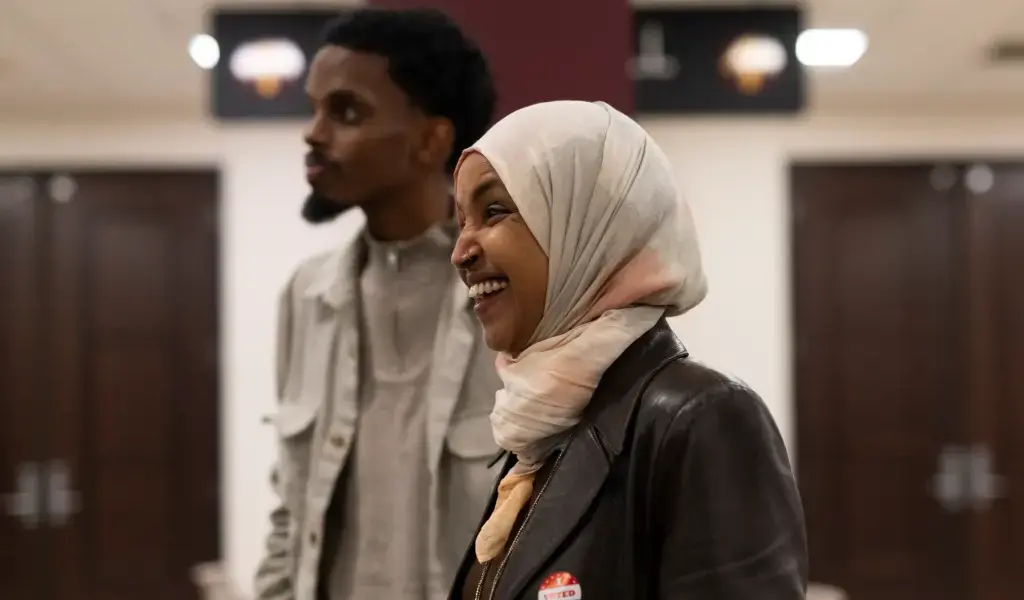

Ilhan Omar stood stunned as hordes of self-described “patriots” flooded Minnesota streets, unleashing an unprecedented wave of protests against her and Democratic leadership. The state, long viewed as an impregnable blue fortress, now faces accusations of rotting from within amid mounting scandals that have even loyalists questioning the status quo.
Unprecedented Patriot Surge Shakes Blue Stronghold
What began as scattered rallies exploded into mass demonstrations, with thousands converging on Minneapolis and St. Paul. Banners decried “corrupt governance” and “failed leadership,” targeting Omar’s district amid reports of chaotic policies and law enforcement breakdowns. Organizers framed it as a “political uprising,” not mere voter swing—a verdict on progressive excesses that have eroded public trust.
Scandals piled high: unaddressed crime spikes, mismanaged budgets, and whispers of insider dealings. Protesters chanted “Enough is enough,” echoing frustrations over sanctuary city debates and economic stagnation. Minnesota’s transformation from safe haven to battleground signals deepening national divides.
Karoline Leavitt Emerges as Conservative Firebrand

At the protests’ forefront stood Karoline Leavitt, the sharp-tongued Trump spokesperson turned agitator. Unafraid of harsh attacks, she lambasted Omar and Gov. Tim Walz as symbols of “stagnant, disconnected power.” Leavitt declared public trust’s collapse inevitable under such “misguided and complacent leadership.”
Her sharpest salvo targeted a staggering $1 billion tax fraud scandal, calling it proof the system “leaks from all sides.” “Do they not see it, or do they deliberately ignore it?” she demanded, spotlighting weak responses that fueled outrage. Leavitt positioned the patriot wave as “deliberate reclamation”—demanding discipline, accountability, and transparency lost to elite complacency.
-
Protest Scale: 50,000+ attendees across 20 cities; live streams hit 10M views.
-
Key Demands: Omar resignation, Walz recall, fraud investigations.
-
Polling Shift: Omar approval plummets to 38%; GOP leads generic ballot 52-45%.
Omar and Walz Scramble Amid Reassurance Efforts

Omar decried the influx as “orchestrated intimidation,” vowing resilience while rallying immigrant communities. Walz activated state resources for “peaceful assembly,” but critics mocked it as tone-deaf amid fraud probes. Their joint pressers aimed to soothe, yet Leavitt’s rebuttals—live-tweeted barbs—amplified chaos.
Democratic insiders leak panic: base turnout risks collapse if scandals fester. National figures like AOC tweet solidarity, but local fractures widen.
Scandals Fueling the Firestorm
The $1 billion tax fraud dominates headlines—alleged schemes siphoning funds from welfare to cronies. Coupled with rising violent crime (up 25% YOY) and botched migrant integrations, it paints a picture of governance failure. Patriots cite ICE raid rumors as overdue justice, linking Omar’s activism to policy woes.
Leavitt hammered: “Minnesota bleeds resources while elites lecture on equity.” Her rhetoric resonates, drawing crossovers from disillusioned independents.
National Eyes on Minnesota’s Turning Point

Observers debate: beginning of earthquake or death knell for blue dominance? Midterm models flip three House seats red; gubernatorial races tighten. Trump signals rally support, boosting patriot morale.
Conservatives hail Leavitt’s rise; progressives warn of “MAGA mob.” Faith leaders call de-escalation; businesses brace boycotts.
Historic Crossroads or Order’s Collapse?
Minnesota embodies America’s reckoning—discontent collides with demands for overhaul. Omar’s stunned silence mirrors elite shock; patriots’ surge signals backlash against sanctuary utopias.
Leavitt’s clarion call—“pull back from the brink”—captures momentum. As protests swell, one question looms: fleeting revolt or seismic shift dismantling decades of one-party rule? The Land of 10,000 Lakes boils; nation watches warily.
GOP Set to Add Another Seat to House In State Redistricting Effort

A nationwide redistricting battle is unfolding as Republican-led legislatures, encouraged by former President Donald Trump, work to expand GOP-leaning congressional districts. In North Carolina, lawmakers are advancing a new map projected to give Republicans an edge in 11 of 14 House seats, joining similar efforts in states like Texas and Missouri. Despite Democratic protests, the proposal has cleared the state Senate, and Governor Josh Stein lacks the power to veto redistricting plans.

Republican officials argue the maps align with voter preferences and reflect Trump’s electoral success, while Democrats denounce them as partisan maneuvers. In contrast, California Governor Gavin Newsom is promoting a ballot initiative that would let the legislature temporarily bypass the state’s independent redistricting commission to add five Democrat-leaning districts, aiming to counter GOP gains elsewhere.
Beyond these high-profile cases, redistricting debates continue in Kansas, Indiana, Ohio, and Utah. With Republicans controlling both legislative chambers and the governorship in 23 states—compared to 15 for Democrats—the GOP maintains a structural edge in shaping congressional maps nationwide, potentially securing a long-term advantage in the House of Representatives.
Erosion of Electoral Competitiveness
Research from recent political science studies indicates that a combination of gerrymandering and geographic polarization is steadily reducing the number of competitive congressional districts. A 2025 academic analysis found that maps drawn with partisan optimization tend to eliminate more than 25% of districts classified as highly competitive under neutral simulations.
If the current trajectory continues, the House of Representatives may see a significant increase in “safe Republican” seats, limiting the ability of national political tides to shift control in future election cycles.
Legal Challenges Mount Across Multiple States
The new congressional map in North Carolina has become one of the most heavily litigated in the nation. In Williams v. Hall (2025), plaintiffs argue that the map violates the 14th and 15th Amendments and Section 2 of the Voting Rights Act by diluting the influence of Black voters in the state’s 1st Congressional District.
Court filings show that the Black voting-age population in District 1 dropped by more than eight percentage points under the new lines. Voting-rights organizations contend that this shift undermines the ability of Black voters to elect candidates of their choice.
Republican lawmakers, however, argue that the map is drawn based on political performance—primarily results from the 2024 elections—rather than race, a distinction allowed under current Supreme Court precedent.
Separately, a state-level lawsuit in North Carolina challenges several state senate districts on allegations of racial gerrymandering. Experts testifying for the plaintiffs used statistical modeling to show correlations between racial demographics and boundary lines, while defense experts argue that the maps reflect political intent, not racial motive.
Similar disputes are active in Kansas, Ohio, Utah, and other states where population shifts and partisan pressures have triggered mid-cycle map revisions.
Impact on Minority Representation
Civil-rights groups warn that the new maps in several states disproportionately reduce the political power of Black, Latino, and Asian communities. In North Carolina, advocates say the map reshuffles counties with significant Black populations into districts where their voting influence is diminished.
Supporters of the new boundaries counter that redistricting inherently alters demographic balances and that partisan considerations—not racial ones—are driving the changes. They argue that if voters disagree with the direction of their legislatures, they can seek remedies through elections or state constitutional reforms.
Long-Term Strategy for Republican Stability
Demographic trends suggest that population growth continues to favor Republican-leaning states like Texas and Florida. By revisiting maps mid-decade—an approach permitted in many states—Republicans aim to capitalize on political momentum following recent elections.
This strategy could result in a multi-cycle advantage in the House, particularly if new maps in GOP-controlled states add several reliably Republican districts while Democratic states remain constrained by independent redistricting commissions or stricter legal standards.
Analysts note that former President Trump’s vocal encouragement of aggressive redistricting has further emboldened Republican governments to act quickly before the 2026 midterms.
Democratic Response and Push for Reform
Democratic lawmakers, election-law scholars, and advocacy groups have responded with a wave of lawsuits and calls for structural reform. Their proposals range from independent redistricting commissions to statutory limits on mid-decade map changes.
Several academic studies support the view that independent commissions or algorithmic mapping standards can increase electoral competitiveness and reduce extreme partisan bias. Advocates argue that federal action may eventually be necessary to restore balance, although congressional gridlock makes such reforms difficult.
Conclusion
The redistricting efforts led by Republican legislatures form part of a broader, long-term strategy to solidify their influence in the House of Representatives. While these maps may provide immediate electoral advantages, they have also triggered extensive legal scrutiny and raised concerns about diminishing minority representation and declining electoral competitiveness.
The outcome of ongoing court battles—and the potential for public demand for structural reform—will determine whether these maps endure or whether the push for fairer, more transparent redistricting gains momentum in the coming years.