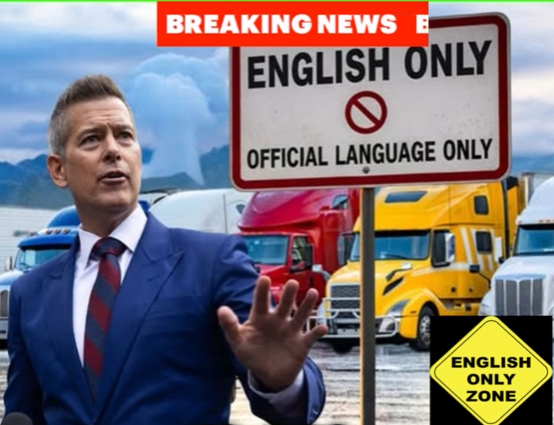
“SPEAK ENGLISH OR PARK THE TRUCK”: DUFFY PURGES 10,000 DRIVERS IN MASSIVE “ZERO TOLERANCE” CRACKDOWN

“SPEAK ENGLISH OR PARK THE TRUCK”: DUFFY PURGES 10,000 DRIVERS IN MASSIVE “ZERO TOLERANCE” CRACKDOWN
WASHINGTON — Transportation Secretary Sean Duffy has officially signaled a new era of “zero tolerance” on American highways. In a move that has ignited a firestorm within the freight industry and panic across the supply chain, Duffy touted the removal of nearly 10,000 commercial truck drivers from U.S. roads after they failed federally mandated English-language proficiency checks.
The enforcement action, which Duffy amplified via social media following a detailed Bloomberg report, marks a dramatic pivot in how the Department of Transportation (DOT) interprets and enforces long-standing safety regulations.
The Mandate: Safety Over Logistics
At the heart of the crackdown is 49 CFR 391.11, a federal regulation requiring commercial drivers to “read and speak the English language sufficiently to converse with the general public, to understand highway traffic signs and signals in the English language, to respond to official inquiries, and to make entries on reports and records.”
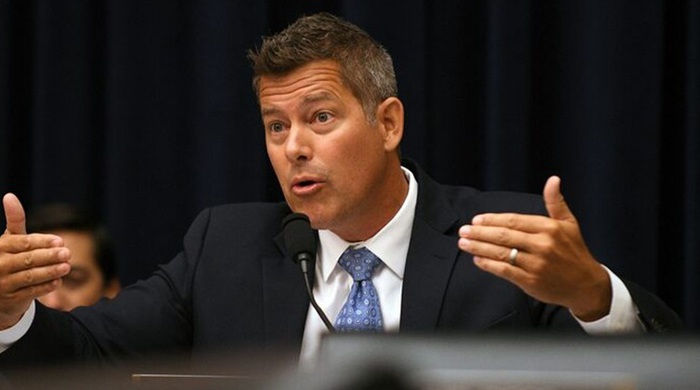
“Safety is non-negotiable,” Secretary Duffy stated, defending the mass disqualification. “If a driver cannot communicate with law enforcement or understand a hazardous materials warning sign, they are a danger to themselves and every family on the road. We are finally enforcing the laws that have been ignored for far too long.”
A Supply Chain in Turmoil
The Bloomberg report highlighted by Duffy reveals the immediate and painful consequences of this policy. Across the nation, trucking operations are being disrupted as thousands of drivers—many of whom are veteran long-haulers—are suddenly disqualified from operating heavy machinery.
Industry leaders are warning that this “language purge” comes at the worst possible time. With the freight industry already facing a significant labor shortage, the removal of thousands of drivers is expected to drive up shipping costs and delay deliveries of essential goods.
“We are effectively parking 10,000 trucks during a period of economic transition,” warned one logistics expert. “The consumer will feel this at the grocery store.”
The Immigration Intersection
The move is widely seen as an extension of the Trump administration’s broader immigration and border policies. By targeting the trucking industry—a sector that relies heavily on immigrant labor—the administration is creating an additional layer of vetting that moves beyond simple work authorization into linguistic compliance.

Critics argue that the move is “targeted” and “punitive,” designed to marginalize non-native speakers who have safely navigated American roads for years. However, proponents point to recent data suggesting that communication barriers have hindered emergency response efforts during multi-vehicle accidents.
The Road Ahead
As Secretary Duffy doubles down on these enforcement actions, the DOT is expected to expand roadside language audits at interstate weigh stations. Drivers who cannot pass a basic verbal assessment with an inspector face immediate “out-of-service” orders.
The freight industry now stands at a constitutional and economic crossroads. For the truckers caught in the middle, the message from Washington is clear: The “One Big Beautiful Bill” of American infrastructure now comes with a mandatory English lesson—or a permanent exit from the driver’s seat.
HOMAN TARGETS OMAR: BORDER CZAR CONFIRMS FEDERAL PROBE INTO CONGRESSWOMAN’S CITIZENSHIP COULD LEAD TO DENATURALIZATION

HOMAN TARGETS OMAR: BORDER CZAR CONFIRMS FEDERAL PROBE INTO CONGRESSWOMAN’S CITIZENSHIP COULD LEAD TO DENATURALIZATION
WASHINGTON — The tension between the executive branch and the most progressive wing of Congress has reached a breaking point. Tom Homan, the Trump administration’s formidable “Border Czar,” has officially confirmed that federal investigators are conducting a comprehensive review of Representative Ilhan Omar’s (D-MN) immigration and naturalization history, focusing on long-standing allegations of immigration fraud.

The move marks a significant escalation in the administration’s “Zero Tolerance” policy, moving the target from anonymous migrants at the border to high-profile political figures in the halls of power.
The “Denaturalization” Strategy
In a series of recent interviews, Homan has emphasized that the law must apply equally to all.
“If it is determined that anyone—regardless of their position—obtained their citizenship through fraudulent means, that citizenship is subject to revocation,” Homan stated firmly. “Immigration fraud is a serious crime that undermines the integrity of our entire nation. We don’t give a pass to people just because they have a ‘Representative’ title in front of their name.”
The investigation reportedly focuses on allegations that Omar provided false information to federal authorities regarding her family history and marital status during her journey from a Kenyan refugee camp to U.S. citizenship in the late 1990s.
The “Marriage Fraud” Allegations
The core of the investigation involves contested claims that Omar married her own brother in 2009 to facilitate his entry into the United States—a claim Omar has repeatedly denied and characterized as “baseless and xenophobic.”
However, Homan’s team suggests that “newly uncovered” documents and potential witness testimony have provided a fresh impetus for the probe. Federal agents are reportedly utilizing the “Denaturalization Task Force” to scrutinize the paper trail. Legal experts note that while denaturalization is a complex and difficult legal process, it is not impossible if “willful misrepresentation” of material facts can be proven in a court of law.
A Political Firestorm
Rep. Ilhan Omar has remained defiant, accusing Homan and the Trump administration of “weaponizing the DOJ” to carry out a “white supremacist agenda.” Her supporters argue that the focus on her history is a distraction from the administration’s own policy failures and an attempt to silence one of the President’s most vocal critics.
“This is not about law; it’s about a vendetta,” stated one advocate for the Somali-American community in Minneapolis. “They are trying to undo the will of the voters by using the immigration system as a political guillotine.”
The Road to the Supreme Court
As Homan ramps up the rhetoric, the nation is bracing for what could be a historic constitutional showdown. If the DOJ were to successfully move for denaturalization, it would set an unprecedented legal pathway for removing a sitting member of Congress.
Tom Homan, true to his reputation, remains undeterred by the political fallout.

“We follow the facts where they lead,” he concluded. “If the facts show fraud, the law demands action. The era of looking the other way is over.”
Whether this leads to a formal indictment or remains a high-stakes war of words, the “Border Czar” has made one thing clear: in the 2025 era of enforcement, no file is too old and no person is too powerful to be audited.