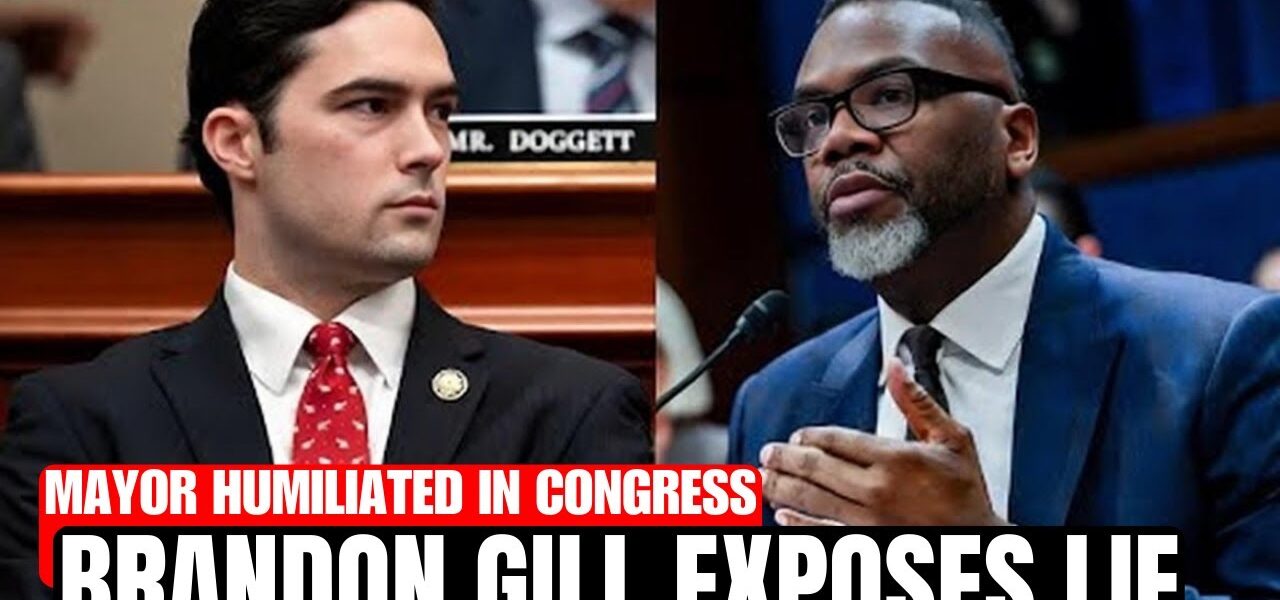

Congressional hearings are designed to produce clarity. Viral hearing clips are designed to produce conflict. The transcript above—featuring Texas Representative Brandon Gill questioning Chicago Mayor Brandon Johnson—contains both: a real dispute over sanctuary-city policy and public spending, and a separate dispute over ethics, gifts, and transparency. It is then wrapped in commentary claiming Gill delivered a “masterclass” in accountability while Johnson “filibustered” and hid a “secret gift room.”
The result is a clip that feels definitive, even though it is not. It is persuasive because it forces the viewer into a binary: either the mayor is a slippery politician refusing to answer basic questions, or the congressman is grandstanding with yes/no demands that flatten complex policy. In reality, the exchange is more revealing—and more complicated—than the narrator admits.
This article breaks down what the transcript actually shows, what is being alleged, and what a fair-minded reader should ask before forming a final verdict.
1. The Two Tracks of the Hearing: Immigration Policy vs. Personal/Institutional Ethics
The questioning has two distinct phases:
Policy phase:
-
- Gill asks a series of “yes or no” questions about Chicago’s approach to undocumented immigrants—driver’s licenses, subsidized health care, reduced college costs, local voting, abortion access, and noncitizen advisory boards.
Ethics phase:
- Gill shifts to gifts—mentioning items such as Hugo Boss cuff links, a Montblanc pin, a Gucci tote bag, a Kate Spade purse, and designer shoes—while claiming Johnson has a “secret gift room” not accessible to the public or the inspector general.
These are related only by narrative. The clip’s commentary tries to fuse them into one moral story: the mayor allegedly spends taxpayer money on noncitizens while personally benefiting from luxury gifts. That fusion is emotionally powerful, but it risks conflating separate questions:
Whether a city should be “welcoming” is a policy debate.
Whether gifts are properly disclosed and controlled is an ethics and compliance debate.
Whether gifts are “personal enrichment” depends on rules, custody, disclosure, and disposition.
A hearing can cover both topics, but a viewer should resist treating them as one proved claim. They require different evidence.
2. The “Yes or No” Trap: Effective Television, Imperfect Governance
Gill opens with tight rules: “If you could answer with a yes or no answer, that’d be great.” He asks:
Do you support allowing undocumented immigrants to obtain driver’s licenses?
Do you support tax dollars subsidizing/paying for their health care?
Do you support free or reduced college for undocumented immigrants?
Do you support allowing noncitizens to vote in local elections?
Do you support taxpayer-funded abortions for undocumented immigrants?
Do you support appointing noncitizens to government advisory boards?
Johnson repeatedly avoids a clean “yes” or “no,” responding with variations of:
“Chicago has been a welcoming city for over 40 years.”
“I support investments in all residents of the people of Chicago.”
“I’m not over the jurisdiction of that type of law.”
Gill then translates the evasive answers into affirmative ones: “I’ll take that as a yes.”
This tactic is common in oversight theater. It does three things at once:
It frames the witness as evasive.
-
- Even if the witness has legitimate nuance, refusing “yes/no” answers makes them look slippery.
It lets the questioner control the record.
-
- If the witness won’t state a position, the questioner supplies one.
It creates a clean clip.
- Viewers remember “that’s a yes” more than a policy explanation.
But there’s a catch: yes/no framing can be unfair if the question bundles multiple issues. “Support taxpayer-funded health care for illegal aliens” could mean many things depending on what’s in scope: emergency care, communicable disease treatment, city-funded clinics, state Medicaid eligibility, or federal programs. A mayor might support some and oppose others. The same applies to “free college,” which might refer to scholarships, in-state tuition, or municipal programs.
So Gill’s format is rhetorically effective—especially for short clips—but it does not necessarily produce accurate policy accounting.
3. The Noncitizen Voting Question: The Transcript Shows a Specific Claim
On noncitizen voting, Johnson says he is not “over the jurisdiction of that type of law,” but Gill counters by citing an article and asserting that Johnson proposed that “all residents, regardless of citizenship status, be able to vote” for Chicago Board of Education members.
If that citation is accurate, it’s a meaningful factual point. But the transcript alone does not verify it. The viewer would need:
the full Sun-Times article
Johnson’s proposal text or public statements
whether it was a campaign concept, a formal ordinance idea, or mischaracterized shorthand
This is an important pattern: the hearing uses a journalistic reference to pin down a position, but the clip does not provide the full source, leaving the audience to trust the speaker.
4. “Welcoming City” as an Answer: Substance or Evasion?
Johnson’s repeated phrase—“welcoming city”—is not meaningless. “Welcoming city” is a policy identity: it signals limits on local cooperation with federal immigration enforcement, access to services, and a stance that municipal government serves residents regardless of status (within what the law allows).
However, as a hearing answer, it functions like a shield. When asked concrete questions about specific benefits and voting, “welcoming city” doesn’t clarify what is actually supported, funded, or authorized.
That is why Gill says: “You’re not going to filibuster here.” In hearing dynamics, witnesses often try to reframe questions into their preferred talking points, and questioners try to force narrow admissions. Both are playing to an audience beyond the room.
5. The Pivot to Crime and “Foreign Terrorist Organizations”
Gill then broadens the frame dramatically, praising President Trump for taking action against “foreign criminal gangs,” designating certain organizations as foreign terrorist organizations, and listing examples like MS-13 (and others as named in the transcript). He argues that as mayor of a sanctuary city, Johnson has been “virtually giving favors to illegal aliens” and directing “an enormous amount of taxpayer resources” to them.
This segment is designed to fuse immigration policy with public safety fear. It implies that “welcoming” policies create a permissive environment for violent transnational crime. That may be a sincerely held view, but it is also a rhetorical escalation that moves away from city budgeting details and into national partisan conflict.
If the goal were strictly oversight of Chicago’s compliance and ethics, this pivot is not necessary. If the goal is to create a moral contrast—criminal gangs vs. luxury gifts—it is strategically perfect.
6. The “Secret Gift Room” Allegation: The Most Serious Charge in the Clip
The hearing becomes most concrete when Gill asserts:
Johnson has a “secret gift room”
it is “not given access to the public” or “to the office of inspector general”
the mayor has received numerous luxury items (cuff links, Montblanc pin, Gucci tote, Kate Spade purse, designer shoes)
and Johnson cannot or will not say who gave them
This is a serious allegation because it implies possible ethics violations: undisclosed gifts, improper acceptance, or an effort to avoid oversight.
But the transcript also contains Johnson’s core defense:
He did not receive the gifts personally.
The gifts were given “to the city of Chicago,” consistent with a long-standing city policy.
The reason Gill knows about them is that “they exist” and are recorded.
If that defense is accurate, then the ethical question shifts from “the mayor is taking bribes” to “how does Chicago handle ceremonial gifts and disclosures?” Many governments have systems where gifts to an office are city property, logged and stored, sometimes displayed, sometimes disposed of, sometimes prohibited above certain thresholds, and sometimes required to be turned over to a specific office.
In other words: a “gift closet” is not inherently corrupt. The corruption question depends on policy and compliance.
7. The Key Detail Gill Presses: Do You Know Who Gave the Gifts?
Gill’s strongest move is not naming luxury brands; it is repeating a simple accountability test:
“Do you know who gave you that?”
“Do you know who gave those to the city of Chicago?”
Johnson repeatedly refuses or sidesteps, returning to “I was invited” and “I’m happy to answer questions around welcoming city.”
From an ethics perspective, knowing the donor matters because:
It reveals potential conflicts of interest.
It allows auditors to assess whether donors had business before the city.
It ensures disclosure rules are being followed.
It prevents “gifts to the office” from functioning as gifts to the person in practice.
If Johnson truly cannot identify donors, that suggests poor recordkeeping. If he can but will not, that suggests concealment or a legal strategy. Either is politically damaging, which is why this part clips well.
However, there’s also a procedural possibility: Johnson may be trying to avoid misstating facts on record, especially if there is an existing advisory from the inspector general, a policy restricting discussion, or pending review. The transcript ends with Gill asking unanimous consent to enter into the record an inspector general advisory concerning gifts accepted on behalf of the city—suggesting there is formal guidance relevant to the dispute.
That IG advisory is exactly the kind of document a responsible viewer would want to read before concluding the “gift room” is illicit.
8. “Reclaiming My Time”: Control, Not Proof
Gill repeatedly says, “I’m reclaiming my time.” That phrase is popular in hearings because it signals dominance: the questioner controls the clock and will not allow long answers that run out time.
It can be justified when a witness is filibustering. It can also be used to prevent context that might weaken the soundbite.
Here, it functions as a narrative accelerator. Gill wants a crisp record: Johnson won’t say who gave the gifts. Johnson wants to reframe the topic back to the hearing’s stated purpose (“welcoming city”). Each is doing what their incentives demand.
But a viewer should notice: control is not evidence. Reclaiming time does not prove corruption. It proves the congressman is skilled at producing a clip.
9. The Commentary’s “Double Standard” Claim: Persuasive, But Not Proven
The narrator claims Gill exposed a “clear double standard” that should upset taxpayers: Johnson is generous with taxpayer resources for undocumented immigrants while receiving luxury gifts.
This is a compelling juxtaposition. But it is still a juxtaposition. To prove a “double standard” ethically, you’d need:
evidence that the gifts personally benefited Johnson (use, retention, undisclosed personal possession)
evidence that donors sought or received city favors in exchange
evidence that access to the gift room is improperly restricted in violation of rules
evidence that Johnson’s policies are illegal or fiscally reckless (not just controversial)
The transcript provides suspicion and tension, not proof of quid pro quo.
10. What Questions Would Actually Settle This?
A real accountability process would ask for documents, not just yes/no answers. The most useful questions would be:
What is Chicago’s written gift policy for the mayor’s office and city officials?
Where is the gift log, and is it public?
For each item named, what is the donor identity, date received, and estimated value?
Who has custody of the items, and what is the process for storage, display, or disposal?
Does the inspector general have access? If not, why not?
Have any donors had contracts, permits, zoning requests, or other matters before the city?
Did Johnson or his staff request any gifts or special treatment?
What is the “welcoming city” mandate Johnson says he was invited to discuss, and why did it limit his answers?
If the answers show transparent logging and IG access, the “secret gift room” framing collapses. If the answers show missing records and restricted oversight, the ethical concern becomes substantial.
Conclusion
The hearing clip succeeds as political content because it combines two powerful storylines: immigration resentment and ethics suspicion. Representative Brandon Gill’s questioning style is sharp and clip-friendly: yes/no demands, time control, and repeated donor questions. Mayor Brandon Johnson’s answers, as shown here, are politically weak: he avoids direct admissions and does not provide donor clarity.
